Africa’s second-largest economy lands $801 million in European Union backing for major power-grid expansion
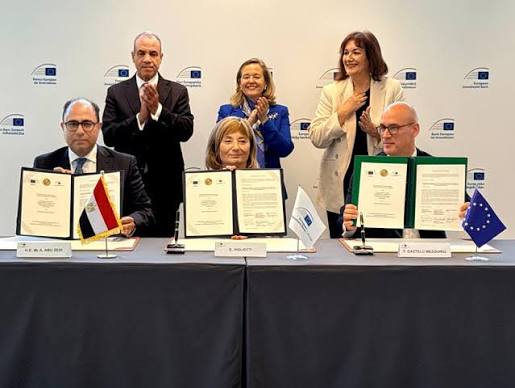
Egypt and the European Union have agreed on a financing package of up to €690 million ($801 million) to modernise the North African country’s electricity network and connect 22 gigawatts of renewable-energy capacity to the grid by 2030.
 Black News
Egypt and the European Union have agreed on a financing package of up to €690 million ($801 million) to modernise the North African country’s electricity network and connect 22 gigawatts of renewable-energy capacity to the grid by 2030.
- Egypt and the European Union agreed on a €690 million financing package to modernise Egypt's electricity grid and connect 22 GW of renewable energy by 2030.
- The funding includes a €600 million loan from EIB Global and up to €90 million in grants from the European Commission, covering 44% of the project's total cost.
- The programme will be led by Egypt’s Electricity Transmission Company, focusing on integrating solar and wind power to supply about 10 million households.
- Compared to previous projects like Morocco’s, the Egypt package is much larger, reflecting the EU's increased focus on grid infrastructure to support Africa's energy transition and cross-border electricity trade.
The package comprises a €600 million loan from EIB Global, the European Investment Bank’s development arm, and grants of up to €90 million from the European Commission.
Led by the state-owned Egyptian Electricity Transmission Company, the programme is expected to integrate enough solar and wind capacity to supply around 10 million households.
The investment highlights Egypt’s strategic position in Europe’s clean-energy plans for North Africa and the Mediterranean.
The country is projected to remain Africa’s second-largest economy in 2026, with nominal gross domestic product estimated at $429.65 billion by the International Monetary Fund, and maintains strong economic and diplomatic ties with Western partners.
Under the programme, Egypt will build modern substations and install advanced transmission lines to connect solar and wind power generated in the Red Sea and Gulf of Suez regions to the national grid.
The EU financing package will cover 44% of the programme’s total cost, while the Egyptian Electricity Transmission Company will fund the balance.
The EIB-backed phase will run from 2027 to 2030, with the Egyptian government borrowing the funds through the Central Bank of Egypt and EETC overseeing implementation.
Once completed, the infrastructure is expected to reduce transmission losses, improve supply reliability and increase the grid’s capacity to absorb electricity from large renewable-energy projects.
“This agreement reflects the strength of the partnership between Egypt and the European Union and our shared determination to advance the green transition,” said Badr Abdelatty, Minister of Foreign Affairs, International Cooperation and Egyptian Expatriates.
“Together with the EIB and the EU, we are taking an important step to modernise our electricity network, strengthen energy security and create new opportunities for sustainable growth. This is the kind of practical cooperation that brings real benefits to our economy and our people.”
Tackling Africa’s grid constraints
The financing targets a major obstacle to Africa’s energy transition: inadequate transmission infrastructure.
Although African countries have attracted growing investment into solar and wind generation, ageing and congested grids have limited their ability to connect projects and supply electricity to homes and businesses.
Consequently, some renewable-energy developments face delays even after investors secure funding for power generation.
By financing substations and transmission lines, the EU and EIB are targeting the infrastructure needed to move renewable electricity from production centres to consumers.
The programme could also generate opportunities for African and European companies operating in engineering, construction, equipment supply and clean-energy technology.
“This project is a very concrete example of what the partnership between Egypt and the European Union can achieve,” said EIB Vice-President Gelsomina Vigliotti.
“By working together, Egypt, the EU and the EIB are supporting the expansion and modernisation of the electricity network, unlocking more renewable energy and strengthening the country’s role as a regional energy hub. For the EIB, this is about backing sustainable growth, greater energy resilience and better opportunities for people and businesses across the country.”
Egypt package surpasses Morocco grid deal
The agreement follows a similar EU-backed investment in Morocco, where the EIB signed a €170 million loan with state utility ONEE in May 2025.
That financing supports a wider €355 million programme to reinforce transmission lines and substations between 2024 and 2029, integrate renewable power and improve grid reliability.
However, Egypt’s €690 million package is more than four times the size of the EIB loan signed with Morocco, underscoring Cairo’s importance in the EU’s energy strategy for North Africa.
The investment is also among the first projects under the Trans-Mediterranean Renewable Energy and Clean-Tech Cooperation Initiative, which seeks to strengthen clean-energy cooperation between the EU and its southern Mediterranean partners.